A survey of artistic developments related to the electronic era, the relationship of computer-facilitated arts to traditional genres and a critical examination of selected contemporary works.
The answer is, you... And for seizing the reins of the global media, for founding and framing the new digital democracy, for working for nothing and beating the pros at their own game, TIME's Person of the Year for 2006 is you.
Sure, it's a mistake to romanticize all this any more than is strictly necessary. Web 2.0 harnesses the stupidity of crowds as well as its wisdom. Some of the comments on YouTube make you weep for the future of humanity just for the spelling alone, never mind the obscenity and the naked hatred.
But that's what makes all this interesting. Web 2.0 is a massive social experiment, and like any experiment worth trying, it could fail. There's no road map for how an organism that's not a bacterium lives and works together on this planet in numbers in excess of 6 billion. But 2006 gave us some ideas. This is an opportunity to build a new kind of international understanding, not politician to politician, great man to great man, but citizen to citizen, person to person. It's a chance for people to look at a computer screen and really, genuinely wonder who's out there looking back at them. Go on. Tell us you're not just a little bit curious.
“Fundamentally, what happens with the activity of the brain is that we are hard-wired to find meaning – from one image to the other we try and make meaning, we try and make a story. Why does one image follow another?”
“The human mind craves story. Many students don’t believe this until we do an exercise in which I give them a certain amount of insert material of a medical operation. I assign half the class to first construct a story for the material and then edit the footage with that story in mind. The other half of the class is given the task of deliberately avoiding a story but to find some other way of arranging the footage. Some choose color, other choose sizes of shots, and some seem to randomly choose the material. The next time the class meets we screen each cut. Amazingly, every year the exact same thing happens – it’s impossible to tell which edits were story based and which were not. Every single version of the scene tells a story, whether it was intentional or not.
Humans crave order and, as a result, they crave story. It is a powerful lesson.”
Norman Hollyn, “Direct Guidance, Remote Guidance and Misguidance: Teaching Editing in a Portable Non-Linear World”
__________________________
“First, from Metz, is that Cinema is structured ‘like a language.’ It isn’t. Second, from Lacan, the idea that the unconscious is structured ‘like a language.’ It isn’t. Language has this imperialistic approach to everything. It’s very successful. It has been the Microsoft of the brain.”
“…we apprehend, we understand the world – through our eyes and through the connection between the eyes and the brain.
Now it’s important to understand that the eye is part of the brain, it selects, it does not pass all the information it receives back along the chain. It edits the information. A fruitful way of thinking about the brain as a system is as a network of non-linear editing machines. The question then is what is being edited and why?”
“The first is that what we follow on the screen is movement, physical movement. And if we are watching, or even if we are dozing off, a movement on the screen will catch our attention even in the periphery of vision.
The eye developed in order to capture movement – as the most effective way for the organism to defend itself against a predator.
Secondly, the brain developed in order to register emotional movement.”
Peter Wyeth, “Looking at Kuleshov: The Matter of Vision and Visual Articulacy”
__________________________
Click here to download a PDF "On the Importance of Relations between Film Cues and Spectators Perception, and the Possibilities of Selective Compression in New Multimedia Technologies," by Arne Lie NTNU Department of Telematics N-7491 Trondheim Norway
__________________________
Click here to download a PDF of Alternative Realities / The Multiverse: A Metaphysical Conundrum, by Fred A. Wynn
"Just as the acceleration of technology has escalated, there has been an increasing plethora of films in the last decade that depict characters in alternative realties. These realities are ones in which not only the characters, but the audience may be initially unaware that these realities are unreal. The realities range from virtual to games to media conceived to fantasy to science and science fiction. Yet they are all bound by the objective of breaking through a barrier that separates them from authentic reality. This loss of discernable reality is more than just a narrative theme, but also a theme of current and emergent philosophies as well the theorical concept on which this study is based; that the inability to discern reality is a deep seated collective fear of society in the 21st Century. We have truly reached the age of technology and our culture reflects this paradigm in time. Thus we find that in these films the fourth phrase of image that is characteristic of the era of simulation is reached. The films and philosophies mirror one another."
Photo credit: John Titor's Time Machine, as posted by him on an internet message board
Kylie Minogue's music video, "Come Into My World," exemplifies a looping narrative - characteristic of new media narratives, from video games to flash animations. (see article "Generation Flash: Turntable and Flash Remixing" - click here.) Does it also suggest a changing world view, one that takes for granted parallel universes?
In the vernacular, "Doppelgänger" has come to refer (as in German) to any double or look-alike of a person—most commonly an "evil twin". The word is also used to describe the sensation of having glimpsed oneself in peripheral vision, in a position where there is no chance that it could have been a reflection.
They are generally regarded as harbingers of bad luck. In some traditions, a doppelgänger seen by a person's friends or relatives portends illness or danger, while seeing one's own doppelgänger is an omen of death. In Norse mythology, a vardøgr is a ghostly double who precedes a living person and is seen performing their actions in advance.
The idea of doppelgängers is also seen in fiction involving time travel and parallel universes. In this case, the doppelgänger really "is" the doubled person, but from a different timeline or different version of the universe.
Do you have an exact double somewhere in the world? Can a person be in two places at once? There are many intriguing accounts throughout history of people who claim to have either encountered apparitions of themselves - their doppelgangers - or have experienced the phenomenon of bilocation, being in two separate locations at the very same time.
"Doppelganger" is German for "double walker" - a shadow self that is thought to accompany every person. Traditionally, it is said that only the owner of the doppelganger can see this phantom self, and that it can be a harbinger of death. Occasionally, however, a doppelganger can be seen by a person's friends or family, resulting in quite a bit of confusion.
In instances of bilocation, a person can either spontaneously or willingly project his or her double, known as a "wraith," to a remote location. This double is indistinguishable from the real person and can interact with others just as the real person would.
For some stories about reported Doppelganger incidences, click here. _______________________________________
Continuing on the science fiction theme of parallel universes, there is the curious case of John Titor. John Titor is the name used by the person or persons claiming to be a time traveler from the year 2036 who posted on several time-travel–related bulletin boards during 2000/2001. In these posts he made numerous ambiguous predictions about events in the near future, starting with events in 2004. Whether or not John Titor was a hoax has been a topic of controversy on web-based paranormal discussion boards.
In his online postings, Titor claimed to be an American soldier from the year 2036 who was assigned to a government time travel project. He was supposedly sent back to 1975 to retrieve an IBM 5100 computer which he claimed was needed to "debug" various legacy computer programs in 2036. According to IBM engineer Bob Dubke, Titor's statements regarding the IBM 5100's ability to emulate and debug mainframe systems were correct. It has been stated that this information was not publicly available when Titor made his declaration. He claimed he was making a stopover in 2000 in order to observe the effects of the Y2K bug, and this is when he started posting to the discussion groups.
When asked why the time machine did not lead to time travel paradoxes, he stated that this was explained through the many-worlds interpretation (or as it was called, the Everett-Wheeler model), which he claimed was proven to be correct in the future. Simplistically, the Many Worlds theory suggests that for any event that could have different possible outcomes, every one of those outcomes occurs in a separate "universe". According to the posts, a time traveler does not actually enter their own past, but some other, similar, past. When asked to use the time machine to perform some paradoxical action, he replied that that would only affect this universe, but not his. He appeared to imply that there were many worldlines, and his time machine could not control its outgoing destination exactly, but could return to a worldline exactly similar to his own home. His originating "worldline" would, in turn, receive a John Titor exactly similar to the original. Therefore, his original "worldline" would indeed receive the benefit of his mission.
For more information on John Titor, visit Wikipedia, or the John Titor web site. ______________________________________
Meeting the Multiverse
To test the theory of parallel universes, or multiverses, a £2.6 billion CERN laboratory is being built, in part to see if it can find evidence of their existence. CERN is the European Organization for Nuclear Research, the world's largest particle physics centre. It sits astride the Franco-Swiss border near Geneva.
CERN is a laboratory where scientists unite to study the building blocks of matter and the forces that hold them together. CERN exists primarily to provide them with the necessary tools. These are accelerators, which accelerate particles to almost the speed of light and detectors to make the particles visible.
"String theory brought to the forefront the idea that there may be more to the universe than just three spatial dimensions — height, width, length — plus time. There could be six more dimensions that we fail to perceive, possibly because they are so tiny and curled up and hidden from view, or perhaps because some are infinite in extension. These new spatial directions are the “warped passages” of the book’s title: a concept that has dominated Randall’s thinking during the last several years. This book is a chronicle of her theoretical adventures within this brave (and strange) new world.
At first, theorists postulated that it was the strings themselves that oscillated within these many dimensions, allegedly creating the various particles found in the cosmos. More recently, that idea has expanded to include membranes, or “branes” for short. A brane is essentially a slice out of that multidimensional world. According to this view, we might be living on a four-dimensional brane (space + time), which itself is immersed inside the full dimensional realm known in its entirety as the “bulk.” Such entities as light waves, electrons, and protons are confined to our specific brane, according to Randall, much like water droplets trapped on a shower curtain.
Given this setup, Randall offers a new and mind-blowing take on the universe — or “multiverse,” as we may be residing amid other branes, other parallel universes, within this complex higher-dimensional domain. “Thinking about branes makes you aware of just how little we know about the space in which we live,” she writes. “The universe might be a magnificent composition linking intermittent branes.” If there is life on those other branes, they likely experience different forces and possibly even different forms of matter. Randall stresses that, despite the science-fiction quality to this notion, evidence for these higher dimensions might actually be obtainable in the foreseeable future. “Experimental tests of competing hypotheses are near at hand, and within a decade,” she predicts, “there should be a dramatic revision in our understanding of fundamental physical laws that will incorporate whatever is discovered....”
Spun is a 2002 independent movie directed by Jonas Åkerlund and written by Creighton Vero and Will de los Santos. This film holds the record for the most cuts per minute in a movie. The film includes more than 5,000 edits. The film was shot in 22 days.
Plot The movie details the lives of individuals surrounding a methamphetamine cook, drug addiction, and the multitude of consequences that can result from drug abuse. The film’s title is a reference to the slang term for the way users feel when being high on the drug. This is Åkerlund's début as a film director after being better known for his work on music videos. The film includes appearances from Rob Halford of Judas Priest fame, Billy Corgan, China Chow, Tony Kaye, Ron Jeremy, and Deborah Harry.
Critical reaction The film got mixed reactions, with some analysts remarking that the film added nothing new to the genre of drug movies. Time Out London was particularly harsh, accusing the film of "smug amoralism", since the director is simply re-using other people's ideas and techniques. Click here to read the article.
Roger Ebert was more empathetic in his review, where he described the film as having "effortlessness wickedness." His main appraisal is the fact that the film in no way attempts to romanticise any of the characters. He does however, expicitly mention the similarities between this and the earlier Requiem for a Dream.
What I find interesting about the movie is: 1. the expansion and contraction of time through the use of special effects and editing techniques 2. the use of filmic, visual based lexicons to simulate inner psycho-physiological states, such as the "speeding up" of mental processes, release of adrenaline, hallucinatory states (cartoon sequences), auditory disturbances and the contraction of time from exhaustion and withdrawal 3. While the film employs traditional "master plots" such as wretched excess and descension, it avoids a solid plot with clear conflict and resolution 4. The clearly digital, non-linear editing techniques add to the synthetic and chemical feel of the film, emulating the effects of methamphetamine addiction 5. The music video/video game visual techniques and pacing of the film help convey the lack of meaning in the crystal meth's life and the quality of "living on the surface."
Click here for information on the VideoDownloader.
Download videos from Youtube, Google, Metacafe, iFilm, Dailymotion... and other 60+ video sites ! And all embedded objects on a webpage (movies, mp3s, flash, quicktime, etc)! Directly!
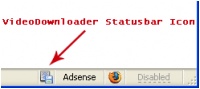
VideoDownloader adds a small icon on the status bar at the bottom of your Firefox window, and a toolbar button. Just click that and download the video you are watching !
Once the file is downloaded (as an "flv" file - otherwise known as "flash video" file) you must rename the file to "nameofvideo.flv. Then you must convert it to an "mpg" in order to use it in Premiere. To do this, you have to download another program called...
Free Riva FLV Encoder 2.0 Transcode your existing Flash Video (FLV) format files with Riva FLV Encoder. Click here to visit the web site where you can download it.
Once you've selected your INPUT Video, you simply change the name of the the OUTPUT Destination Video File extension to "mpg." Then click the Encode button. It'll take a few minutes, but the mpg video will appear (wherever you saved it).
If you're using an Apple/Mac, try this link for a video download: http://www.apple.com/downloads/macosx/video/visualhub.html.
Editing is one of the most creative aspects of filmmaking. The film editor, in conjunction with the director, establishes the pace and structure of a film by connecting various shots to create scenes and sequences that form the final movie. The shots the editor chooses and the ways they are combined set the mood, develop the action, create the rhythm, establish the film's time and space, and guide the viewers' attention. For a typical feature-length film, the editor begins with hundreds of thousands of feet of film and must reduce it to less than 10,000 feet.
In the 1920s, Russian filmmaker Lev Kuleshov conducted a series of experiments designed to demonstrate that when two separate shots are projected in succession, the viewer assumes a connection between them. In one experiment, Kuleshov spliced together a series of shots that had been taken in different places and at different times. The shots were of a waiting man, a walking woman, a gate, a staircase and a mansion. Kuleshov's viewers—who interpreted the sequence as a man and a woman meeting at the gate in front of the mansion—had, in essence, inferred a whole narrative on the basis of seeing only portions of it. This effect allows filmmakers to use exteriors and interiors miles apart and imply that they are in the same place, to have people filmed on different days appear to be talking to each other, to have actors seemingly facing dangerous situations, or to imply that what actors are thinking about is represented by a subsequent cutaway image.
The Kuleshov effect is an editing technique that illustrates how the human brain tries to find connections between objects when viewed together. Other editing techniques rely on how the human eye works. For example, there usually must be an appropriate change in distance for a shot not to seem like a mistake or "jump" cut. The direction in which things move across the screen is also an editorial concern. A car that exits the screen on the right is expected in a subsequent shot to reappear on the left—otherwise the car could be perceived as a different car coming from the opposite direction. Scenes featuring characters in opposition to each other (a hero and villain, for example) usually feature one character continually facing one direction with the other character continually facing the other direction. This keeps the two "sides" clear.
Storyboarding
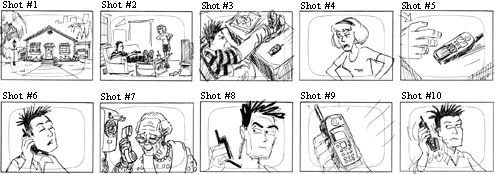
Here is an example of a shot list for the comic strip illustrated below.
1. LS - Exterior of house. Day. 2. LS - Mom to boy. Boy facing right, Mom facing left. "You should call your Grandma." 3. MS - Overhead. Boy staring at phone facing right. Phone on right side of screen. 4. CU - Mom's face. Mom facing left. "You should call your Grandma." 5. ECU - Boy picking up phone. Hand enters from left side of screen. 6. CU - Boy on phone. Phone on left side of screen. Boy's right ear. "Hello, Grandma." 7. CU - Grandma on phone. Grandma facing left. "Why don't you call more often?" 8. CU - Boy staring at phone. Phone on left side of screen. 9. ECU - Phone. Boy's hand on left side. 10. CU - Boy hanging up phone. Phone on left side of screen. Boy looking at phone.
What happens if, instead of the current sequence, the panels are placed in a different order?
Example #1—1, 7, 6, 9, 10, 2 ,3, 4, 5, 8 (Grandma has called the boy from her house and, after hanging up, the boy is told to call his Grandma by his Mom.) Example #2—5, 8,1, 7, 6, 9, 10, 2, 3, 4 (The boy calls Grandma, she admonishes him, the Mom says to call Grandma, and after he doesn't respond, reminds him again.)
Example #3—1, 3, 7, 5, 6, 9,10, 2, 4, 8 (The boy thinks about calling his Grandma, imagines what she would say, calls her, hangs up, and is told to call her by the Mom.)
Montage
Film editing can have its own unique logic as well, functioning in much the same manner as the brain with seemingly jumbled thoughts and images creating their own individual meaning. The groundwork for many of these techniques, later used by Alfred Hitchcock and others, was laid by a group of Soviet filmmakers—most notably Lev Kuleshov, Sergei Eisenstein and Vsevolod Pudovkin—who, in the early 1920s, began to experiment with film style and technique and especially with montage.
Montage, or collision editing, is done by splicing together a rapid sequence of carefully selected shots to evoke a specific emotional or intellectual response. The Russians' premise was that each shot derived meaning from the context in which it was placed. If the context changed, the meaning of the shot and the sequence also changed.
Montage, in the modern sense of the word, often refers to sequences where several shots have been edited together to compress a series of events that happen over time (e.g., sequences of young couples falling in love, scenes with flying calendar pages, etc.). Psycho
In Psycho, Alfred Hitchcock's famous shower scene uses a rapid series of extreme close-ups to build suspense and heighten the sense of panic. Many viewers believe they have seen a very brutal stabbing, even though the knife is never shown piercing the body of the victim.
Potemkin
This sequence in Sergei Eisenstein's 'Potemkin', one of the most famous in film history, recounts the brutal suppression of Russian workers and sympathizers following the death of proto-revolutionary figure Vakulinchuk onboard the Potemkin. Crewmen on the ship had mutinied due to oppressive working conditions and when they arrive at Odessa townspeople came to pay respects for Vakulinchuk and support the workers ... the film itself is based upon the failed 1905 Russian Revolution ... the Odessa sequence is a frightening precursor of government suppression of dissent throughout the 2Oth century, including, but certainly not limited, to Hungary (1956), Czechoslovakia (1968), Soweto (1976), Tiananmen Square (1989) - even Kent State (1970).
The Odessa Steps sequence in Eisenstein's The Battleship Potemkin, is the classic example of montage. In this sequence, the Czar's army is quashing an uprising. Eisenstein uses editing to show the fear of the people, their escalating panic, the tragedy of innocent bystanders as a baby in a carriage careens helplessly down the steps, and the intensifying threat of the soldiers, their guns and artillery.
For more information on narrative structures and post-production, click here and click here for class notes (courtesy and copyright of Prof. Christopher Moore).
JANET MURRAY: "HARBINGERS OF THE HOLODECK"
Murray, Janet. (1997). "Harbingers of the Holodeck", Hamlet on the Holodeck. New York: Free Press, 1997.
The final quarter of the twentieth century marks the beginning of the digital age. Starting in the 1970s, computers have become cheaper, faster, more capacious, and more connected to one another at exponential rates of improvement, merging previously disparate technologies of communication and representation into a single medium. The networked computer acts like a telephone in offering one-to-one real-time communication, like a television in broadcasting moving pictures, like an auditorium in bringing groups together for lectures and discussion, like a library in offering vast amounts of textual information for reference, like a museum in its ordered presentation of visual information, like a billboard, a radio, a gameboard, and even like a manuscript in its revival of scrolling text. All the major representational formats of the previous five thousand years of human history have now been translated into digital form. There is nothing that human beings have created that cannot be represented in this protean environment, from the cave paintings of Lascaux to real-time photographs of Jupiter, from the Dead Sea Scrolls to Shakespeare's First Folio, from walk-through models of Greek temples to Edison's first movies. And the digital domain is assimilating greater powers of representation all the time, as researchers try to build within it a virtual reality that is as deep and rich as reality itself.
The technical and economic cultivation of this fertile new medium of communication has led to several new varieties of narrative entertainment. These new storytelling formats vary from the shoot-'em-up videogame and the virtual dungeons of Internet role-playing games to the postmodern literary hypertext. This wide range of narrative art holds the promise of a new medium of expression that is as varied as the printed book or the moving picture. Yet it would be a mistake to compare the first fruits of a new medium too directly with the accustomed yield of older media. We cannot use the English theater of the Renaissance or the novel of the nineteenth century or even the average Hollywood film or television drama of the 1990s as the standard by which to judge work in a medium that is going through such rapid technical change. In 1455, Gutenberg invented the printing press-but not the book as we know it. Books printed before 1501 are called incunabula; the word is derived from the Latin for swaddling clothes and is used to indicate that these books are the work of a technology still in its infancy. It took fifty years of experimentation and more to establish such conventions as legible typefaces and proof sheet corrections; page numbering and paragraphing; and title pages, prefaces, and chapter divisions, which together made the published book a coherent means of communication. The garish videogames and tangled Web sites of the current digital environment are part of a similar period of technical evolution, part of a similar struggle for the conventions of coherent communication.'
Similarly, new narrative traditions do not arise out of the blue. A particular technology of communication-the printing press, the movie camera, the radio-may startle us when it first arrives on the scene, but the traditions of storytelling are continuous and feed into one another both in content and in form. The first published books were taken from the manuscript tradition. Malory's Morte darthur, written in manuscript in 1470, drew on prose and poetry versions of the Carnelot legend in both French and English, which in turn drew on centuries of oral storytelling. The elements of the story were all there already: the rise and fall of the hero Arthur, the gallantry of the knights, the love between Guinevere and Lancelot, and the destruction of the Round Table through civil war. But Malory's prose brought these elements together and introduced colloquial dialogue, more consistent plotting, and a pervasive tone of nostalgia. Fifteen years later, William Caxton took Malory's separate tales and bound them together into a single volume, with descriptive chapter headings that lured readers into the story. Only then, after such long episodic narratives were commonplace in publishing, could Cervantes write a contemporary tale like Don Quixote (1605), which marks the begin, ning of the European novel.
We can see the same continuities in the tradition that runs from nineteenth-century novels to contemporary movies. Decades before the invention of the motion picture camera, the prose fiction of the nineteenth century began to experiment with filmic techniques. We can catch glimpses of the coming cinema in Emily Brontë's complex use of flashback, in Dickens' crosscuts between intersecting stories, and in Tolstoy's battlefield panoramas that dissolve into close-up vignettes of a single soldier. Though still bound to the printed page, storytellers were already striving toward juxtapositions that were easier to manage with images than with words.
Now, in the incunabular days of the narrative computer, we can see how twentieth-century novels, films, and plays have been steadily pushing against the boundaries of linear storytelling. We therefore have to start our survey of the harbingers of the holodeck with a look at multiform stories, that is, linear narratives straining against the boundary of predigital media like a two-dimensional picture trying to burst out of its frame.
Click here to read the rest of the article and learn about "mutliform" narrative.
Some of the terminology that a film editor uses includes:
Close-up (CU): A shot showing a detail only (ex., face only or hands only).
Cross-cutting: Cutting back and forth between two or more events or actions that are taking place at the same time but in different places. Cross-cutting is used to build suspense or to show how different pieces of the action are related.
Cut:An abrupt transition from one shot to another.
Cutaways: A cut away from the primary subject to something the filmmaker has decided is equally or more relevant at that time. Often cutaways consist of shots showing the reaction of one character to another. This is often used to compress time in what appears to be a seamless manner.
Dissolve: An overlapping transition between scenes where one image fades out as another fades in. Editors often use this to indicate a change in time and/or location.
Establishing Shot: A shot, usually taken from a distance, which establishes for the viewer where the action is to occur and the spatial relationship of the characters and their setting.
Extreme Close-Up(ECU): A detail of a close-up (eyes or mouth only, etc.).
Fade In: A shot that starts in darkness and gradually lightens to full exposure.
Fade Out: A shot that starts at full exposure and gradually fades to black.
Freeze-Frame: At a chosen point in a scene, a particular frame is printed repeatedly, given the effect of halting or "freezing" the action.
Jump Cut: A cut where two spliced shots do not match in terms of time or place. A jump cut gives the effect that the camera is literally jumping around.
Long Shot (LS): A shot taken at a considerable distance from the subject. A long shot of a person is one in which the entire body is in frame.
Medium Shot (MS): A shot framing a subject at a medium range, usually a shot from the waist up.
Reverse cutting: A technique alternating over-the-shoulder shots showing different characters speaking. This is generally used in conversation scenes.
Sequence Shot: An entire scene or sequence that is one continuous camera shot. There is no editing.
In a culture largely informed by a strong visual bias, the rich world of sound is often overlooked, or overestimated in its power to communicate. Hearing and vision provide us access to separate, yet overlapping worlds.
Click here to read course notes on Aural Literacy (courtesy and copyright of Prof. Christopher Moore).
Acoustic Ecology Barry Truax, Director of Research, World Soundscape Project, Department of Communication, Simon Fraser University, Burnaby, B.C. "As researchers into every aspect of the acoustic environment, we feel that this paradox reveals the tendency of our culture to trade its ears for its eyes, that is, to rely more heavily on visual information and less and less on aural cues. One reads of blind people a few centuries ago leading normal, productive lives, compensating for their lack of visual sense by an amazingly acute aural faculty, and yet today the obliteration in both urban and rural environments of the subtle acoustic information that allowed such normal orientation and activity has turned this deficiency into a handicap. The areas now barred to these people (operating a motor vehicle, visual media, many industrial and scientific occupations, the many aspects of formal education now made difficult) reveal fundamental biases of our culture toward the visual in its vital institutions and conventions.
The same bias is abundantly apparent in the ways our society has contrived to talk about sound. Most of the visual terms already mentioned have been taken over directly into the sound vocabulary or translated analogously [compare AUDIOCENTRIC]. Colloquial language is similarly invaded: "Seen in this light, one must review each person's background, you see, and focus attention on putting the entire spectrum of viewpoints into perspective, having the foresight to overlook no apparent alternative that would cast a visible shadow of doubt or reflect an inability to make one's basic outlook transparently clear from any vantage point."
While the visual bias of such cliches may be merely amusing, the negative effects of the sonically imbalanced living environments of the world's industrialized nations are not. It is our contention that the cause of this predicament can be traced to the public's waning auditory skills - a basic inability to hear clearly by those responsible for this imbalance, by which we mean to include as much the citizen who buys noisy appliances and vehicles, as the architects who build noise into their (visually and structurally) advanced designs, and the manufacturers who do the same with products that are thoughtlessly unleashed into the sonic environment regardless of their harmful effects."
Generation Flash: Turntable and Flash Remixing It became a cliché to announce that “we live in remix culture.” Yes, we do. But is it possible to go beyond this simple statement of fact? For instances, can we distinguish between different kinds of remix aesthetics? What is the relationship between our remixes made with electronic and computer tools and such earlier forms as collage and montage? What are the similarities and differences between audio remixes and visual remixes? Click here to read the rest of the article by Lev Manovich.
It's easy to create or repair paperback books using Japanese bookbinding techniques. Just punch four holes through the book near the spine and lash it together with needle and thread. You can make sketch books, scrapbooks or blank books this way, too. To make smaller books, fold several sheets of paper paper carefully into halves or quarters, clamp the stack together and punch and bind it, then slit the pages apart with a sharp knife afterwards, being careful not to cut the binding threads.
Click here to read more instructions on the Japanese bookbinding technique.
Sony patent takes first step towards real-life Matrix
* 07 April 2005 * Exclusive from New Scientist Print Edition. * Jenny Hogan * Barry Fox
IMAGINE movies and computer games in which you get to smell, taste and perhaps even feel things. That's the tantalising prospect raised by a patent on a device for transmitting sensory data directly into the human brain - granted to none other than the entertainment giant Sony.
The technique suggested in the patent is entirely non-invasive. It describes a device that fires pulses of ultrasound at the head to modify firing patterns in targeted parts of the brain, creating "sensory experiences" ranging from moving images to tastes and sounds. This could give blind or deaf people the chance to see or hear, the patent claims.
Click here to read the rest of the New Scientist article. _____________________________________________ Mind Games New on the Internet: a community of people who believe the government is beaming voices into their minds. They may be crazy, but the Pentagon has pursued a weapon that can do just that.
Click here to read the rest of the Washington Post article. ______________________________________________ HIGH FREQUENCY ACTIVE AURORAL RESEARCH PROGRAM (HAARP) HAARP (High frequency Active Auroral Research Program) is to be a major Arctic facility for upper atmospheric and solar-terrestrial research. HAARP is being built on a DoD-owned site near Gakona, Alaska. Principal instruments include a high power, high-frequency (HF) phased array radio transmitter (known as the Ionospheric Research Instrument, or IRI), used to stimulate small, well-defined volumes of ionosphere, and an ultra-high frequency (UHF) incoherent scatter radar (ISR), used to measure electron densities, electron and ion temperatures, and Doppler velocities in the stimulated region and in the natural ionosphere. To further the scientific capabilities and usefulness of the IRI and ISR, HAARP is supporting the design and installation of the latest in modern geophysical research instruments, including an HF ionosonde, ELF and VLF receivers, magnetometers, riometers, a LIDAR (LIght Detection And Ranging) and optical and infrared spectrometers and cameras which will be used to observe the complex natural variations of Alaska's ionosphere as well as to detect artificial effects produced by the IRI.
Click here to visit the HAARP web site. ______________________________________________ Electromagnetic Mind Control Mind Control (Electronic)
Can the government, or more appropriately, the CIA, read your thoughts? Even worse, can they "Implant Thoughts" into your head? Would that be the ultimate Mind Control, if they could control what you actually think and yet, you could never even detect it?
There is overwhelming evidence to suggest this is the case.
Electronics and sound come together when you are dealing with frequency. You can create an electronic device to produce specific frequencies. Frequencies, by themselves can shatter glass, explode an object, including a person, and effect the nature of energies already present at various earth locations. Frequencies combined with particular oscillation rates can do things you wouldn't even imagine. So, what has the military been doing with this technology?
There is speculation that HAARP involves elements of this "Electronic Mind Control". There is a system of Towers around the United States that are linked to HAARP in Alaska.
The specific technology used to accomplish this is called " RHIC-EDOM", which stands for "Radio-Hypnotic Intracerebral Control & Electronic Dissolution of Memory".
NEWS BRIEF: "United States Patent 5,159,703, Lowery, October 27, 1992 Silent Subliminal Presentation System, Inventors: Lowery, Oliver M. Appl. No. 458339 Filed December 28, 1989.
"Abstract: A silent communications system in which nonaural carriers, in the very low or very high audio frequency range or in the adjacent ultrasonic frequency spectrum, are amplitude or frequency modulated with the desired intelligence and propagated acoustically or vibrationally, for inducement into the brain, typically through the use of loudspeakers, earphones or piezoelectric transducers. The modulated carriers may be transmitted directly in real time or may be conveniently recorded and stored on mechanical, magnetic or optical media for delayed or repeated transmission to the listener." ______________________________________________ Montreal woman seeks class-action approval over CIA mind control experiments Wed Jan 10, 6:08 PM By Dene Moore MONTREAL (CP) - Patients were put in isolation, tied down or drugged, and subjected to hours and hours of taped recordings meant to brainwash them at the behest of the Central Intelligence Agency.
They were subjected to massive electroshocks, experimental drugs and LSD, most of them unwilling and unknowingly part of the U.S. spy agency's experimentation, a Federal Court judge was told Wednesday.
To read the rest of the article, click here. ______________________________________________ Nagle, a 25-year-old quadriplegic, is the first human fitted with the BrainGate Neural Interface. He can whip you at Pong without lifting a finger.
Mind Control Matt Nagle is paralyzed. He's also a pioneer in the new science of brain implants. By Richard MartinPage, Wired Magazine
Matthew Nagle is beating me at Pong. "O, baby," he mutters. The creases in his forehead deepen as he moves the onscreen paddle to block the ball. "C'mon - here you go," he says, sending a wicked angle shot ricocheting down the screen and past my defense. "Yes!" he says in triumph, his voice hoarse from the ventilator that helps him breathe. "Let's go again, dude."
The remarkable thing about Nagle is not that he plays skillfully; it's that he can play at all. Nagle is a C4 quadriplegic, paralyzed from the neck down in a stabbing three years ago. He pilots a motorized wheelchair by blowing into a sip-and-puff tube, his pale hands strapped to the armrests. He's playing Pong with his thoughts alone.
Easily generate cool text-images from almost any picture you have on your computer. Click here to visit Text-Images.
Click here to view class notes on Text As Image. Copyright and courtesy of Prof. Christopher Moore.
Click here to read class notes on the Invention of Writing. Copyright and courtesy of Prof. Christopher Moore.
The World as Text?
Virtual Reality It is unclear exactly where the future of virtual reality is headed. In the short run, the graphics displayed in the HMD will soon reach a point of near realism. The aural aspect will move into a new realm of three dimensional sound. This refers to the addition of sound channels both above and below the individual. The virtual reality application of this future technology will most likely be in the form of over ear headphones.
With our technological limits today, sight and sound are the only two senses that will be able to be replicated almost flawlessly. There are however attempts being currently made to simulate smell. The purpose of current research is linked to a project aimed at treating Post Traumatic Stress Disorder (PTSD) in veterans by exposing them to combat simulations, complete with smells. Although it is often seen in the context of entertainment by popular culture, this illustrates the point that the future of VR is very much tied into therapuetic, training, and engineering demands. Given that fact, a full sensory immersion beyond basic tactile feedback, sight, sound, and smell is unlikely to be a goal in the industry. It is worth mentioning that simulating smells, while it can be done very realistically requires costly R&D to make each odor, and the machine itself is expensive and specialized, using capsules tailor made for it. Thus far basic, and very strong smells such as burning rubber, cordite, gasoline fumes, and so-forth have been made. Something complex such as a food product or specific flower would be prohibitively expensive (see the perfume industry as an example).
In order to engage the other sense of taste, the brain must be manipulated directly. This would move virtual reality into the realm of simulated reality à la The Matrix. Although no form of this has been seriously developed at this point, Sony has taken the first step. On April 7, 2005, Sony went public with the information that they had filed for and received a patent for the idea of the non-invasive beaming of different frequencies and patterns of ultrasonic waves directly into the brain to recreate all five senses.[2] There has been research to show that this is possible. Sony has not conducted any tests as of yet and says that it is still only an idea.
Impact There has been increasing interest in the potential social impact of new technologies, such as virtual reality (as may be seen in utopian literature, within the social sciences, and in popular culture). Mychilo S. Cline, in his book, Power, Madness, and Immortality: The Future of Virtual Reality, argues that virtual reality will lead to a number of important changes in human life and activity. He argues that:
* Virtual reality will be integrated into daily life and activity and will be used in various human ways. * Techniques will be developed to influence human behavior, interpersonal communication, and cognition (i.e., virtual genetics).[3] * As we spend more and more time in virtual space, there will be a gradual “migration to virtual space,” resulting in important changes in economics, worldview, and culture. * The design of virtual environments may be used to extend basic human rights into virtual space, to promote human freedom and well-being, and to promote social stability as we move from one stage in socio-political development to the next.
Herbert Marshall McLuhan CC (July 21, 1911 - December 31, 1980) was a Canadian educator, philosopher, and scholar-- a professor of English literature, a literary critic, and a communications theorist. McLuhan's work is viewed as one of the cornerstones of the study of media ecology. McLuhan is well-known for coining the expressions "the medium is the message" and the "global village". Quoted from Wikipedia.
Perhaps the most celebrated English teacher of the twentieth century, McLuhan was a fixture in media discourse from the late 1960s to his death and he continues to be an influential and controversial figure. Years after his death he was named the "patron saint" of Wired magazine.
Global Village The book is no longer "king," says Marshall McLuhan, a professor at the University of Toronto's St. Michael's College. McLuhan studies the effects of mass media on behaviour and thought. In this CBC report on the teenager, he discusses how our youth facilitate the global shift from print to electronic media. Television has transformed the world into an interconnected tribe he calls a "global village."
There's an earthquake and no matter where we live, we all get the message. And today's teenager, the future villager, who feels especially at home with our new gadgets — the telephone, the television — will bring our tribe even closer together.
Click here to view video on the World is a global village. Click here to visit Marshall McLuhan's web site.
When Marshall McLuhan first coined the phrases "global village" and "the medium is the message" in 1964, no-one could have predicted today's information-dependent planet. No-one, that is, except for a handful of science fiction writers and Marshall McLuhan. Understanding Media was written twenty years before the PC revolution and thirty years before the rise of the Internet. Yet McLuhan's insights into our engagement with a variety of media led to a complete rethinking of our entire society. He believed that the message of electronic media foretold the end of humanity as it was known. In 1964, this looked like the paranoid babblings of a madman. In our 21st century digital world, the madman looks quite sane. Understanding Media: the most important book ever written on communication. Ignore its message at your peril.
The Medium is the Massage is Marshall McLuhan's most condensed, and perhaps most effective, presentation of his ideas. Using a layout style that was later copied by Wired, McLuhan and coauthor/designer Quentin Fiore combine word and image to illustrate and enact the ideas that were first put forward in the dense and poorly organized Understanding Media. McLuhan's ideas about the nature of media, the increasing speed of communication, and the technological basis for our understanding of who we are come to life in this slender volume. Although originally printed in 1967, the art and style in The Medium is the Massage seem as fresh today as in the summer of love, and the ideas are even more resonant now that computer interfaces are becoming gateways to the global village.
A form is an abstract property or quality. Take any property of an object; separate it from that object and consider it by itself, and you are contemplating a form. For example, if you separate the roundness of a basketball from its color, its weight, etc. and consider just roundness by itself, you are thinking of the from of roundness. Plato held that this property existed apart from the basketball, in a different mode of existence than the basketball. The form is not just the idea of roundness you have in your mind. It exists independently of the basketball and independently of whether someone thinks of it. All round objects, not just this basketball, participate or copy this same form of roundness.
Jan Tschichold, diagram from The New Typography, 1928, attacking the conventional use of symmetrical page layouts
"A powerful metaphor has informed post-war education in graphic design: the concept of a “language of vision.” This abstract “language” of line, shape, and color has been theorized as a system of visual communication analogous to but separate from verbal language, a distinct code grounded not in cultural convention but in universal faculties of perception."
"In all the arts there is a physical component which can no longer be considered or treated as it used to be, which cannot remain unaffected by our modern knowledge and power. For the last twenty years neither matter nor space nor time has been what it was from time immemorial. We must expect great innovations to transform the entire technique of the arts, thereby affecting artistic invention itself and perhaps even bringing about an amazing change in our very notion of art." Paul Valéry, Pièces sur L’Art, 1931





![• The Anatomy of a Life and Style Cover [Gawker]](http://classes.uleth.ca/200603/nmed1000b/3/howtophotoshop.jpg)